

The War My Aunt Predicted
She wrote the poem decades before I had children. I finally understand it.

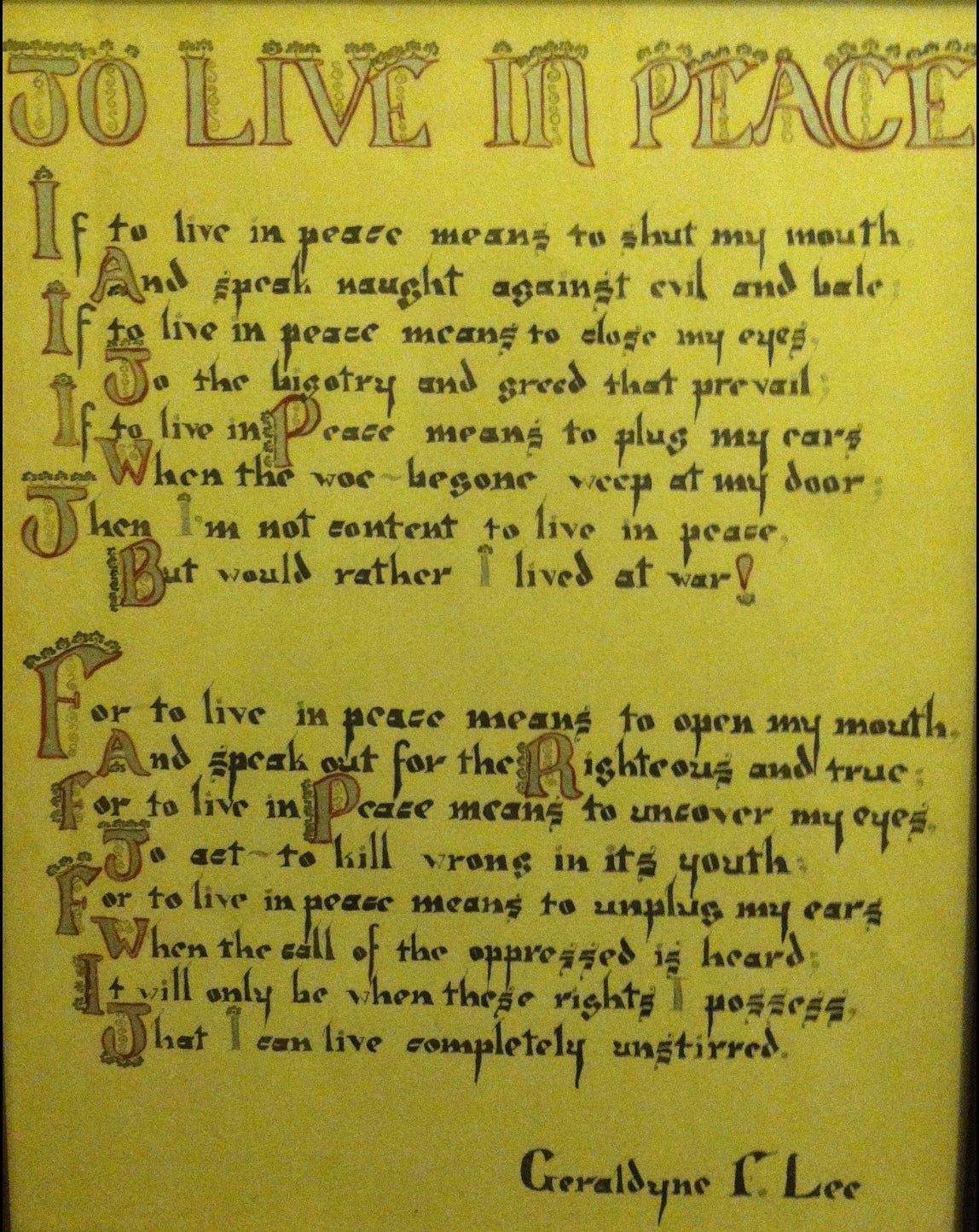
My aunt wrote a poem. It hung on the wall of my parents’ home in Manchester, Connecticut for most of my childhood. I walked past it hundreds of times. I never stopped to read it. I was a kid. I didn’t know what it meant.
I do now.
After my divorce in 2008, I asked my mother if I could take the framed poem back to New York with me. It hangs on my wall today. When I read it now, I understand every word of it in a way I never could have as a boy growing up in that house.
If to live means to shut my mouth, and speak naught against evil and hate; if to live in peace means to close my eyes, to the bigotry and greed that prevail; then I’m not content to live in peace, but would rather I live at WAR.
I walked out of a courthouse on July 9, 2008 and stood on the sidewalk for a minute. Just stood there. I had just finalized my divorce settlement. I had two kids. I had spent months inside a system that had already decided, before I walked through the door, what my role was supposed to be. Pay. Leave. Show up every other weekend. Be grateful for the access. I didn’t accept that. Not because I was angry. Because I knew my kids. I knew what they needed. And what they needed was their father. Not a visitor who showed up twice a month with tickets to something.
Nobody handed me that. I had to fight for it inside a system that was not built for fathers who refuse to disappear.
I stood on that sidewalk relieved. And what settled in underneath the relief was this: the family court system is not designed to produce good outcomes for children. It is designed to process cases. Mothers default to custody. Fathers default to support. The attorneys get paid. The judges move on. The kids grow up in whatever arrangement the system produces, whether it serves them or not.
I watched it happen to men around me. Good fathers. Present fathers. Men who loved their kids and had no idea they were about to be reclassified as a payment source. Some of them never recovered. Not financially, not emotionally, not in terms of their relationship with their children. The system didn’t break them all at once. It wore them down. Bill by bill. Hearing by hearing. Until staying felt impossible and leaving felt inevitable.
I’m not making the policy argument today. That comes in the next piece. Today I’m just telling you what it felt like to be inside it.
READ: I Walked Out of Family Court and Started Asking Questions -What I found should concern every parent in America.
My children are grown now. They know where I was during their childhood. They know I didn’t go anywhere. They know I fought. They didn’t need me to tell them. They were there. That is the only thing I’m certain I got right in all of this. I stayed. Everything else I could have done better. I made mistakes as a father. I made mistakes as a husband. I’m not writing this to cast myself as the hero of anything.
I’m writing it because nobody told me what I was walking into. Nobody warned me how the system worked, what my rights actually were, or what it was going to cost me to exercise them. I figured it out as I went, and it cost more than I expected. Financially, emotionally, in every direction. And I know I’m not the only one who walked into that courthouse blind.
The poem my aunt wrote had no idea it would become the thesis of the second half of my life. She wrote it long before I had children, long before I had any idea what a family court even was. But I read it today and it sounds like she wrote it for exactly this. Like she saw it coming.
For to live in peace means to open my mouth, and to speak out for righteous and true. It will only be when these rights I possess, that I can live completely unstirred.
There are fathers being processed out of their children’s lives right now while the system that’s doing it calls itself a protector. There are men carrying debt they will never escape for children they were never allowed to raise. There are kids growing up without their fathers not because those fathers left, but because a courthouse made leaving the path of least resistance. I cannot live in peace with any of that. I cannot treat it as normal, as inevitable, as just the way things go when a marriage ends.
So I keep writing.
This is the first of four pieces on fatherhood, family court, and what it costs to stay.